When An Entire Brand Category Suffers
How the bus industry in Malaysia is failing
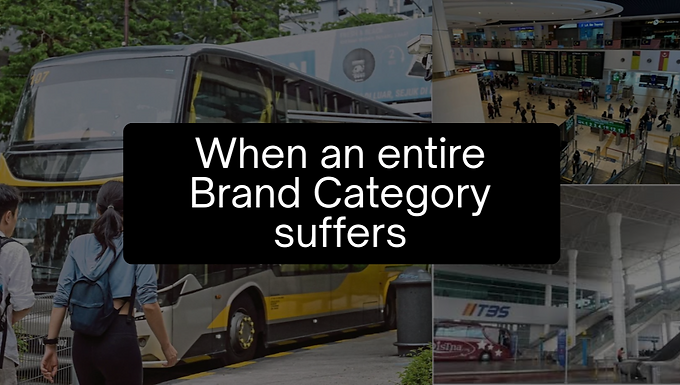
In 2016, I worked a minimum wage role.
For 2 months straight, I did nothing except sell express bus tickets at a kiosk.
I would have never dreamt of working in TBS. Maybe it was plausible if the role was to manage a systems integration project or to work on turning the station into a branded destination. But selling tickets? Unreal. Even to this day, the experience seems like a parallel universe phenomenon.
TBS or Terminal Bersepadu Selatan is the main southern entry point to Kuala Lumpur (KL) for buses, and it serves as an interchange station for trains. Completed in 2010, TBS helped to alleviate the traffic congestion in Puduraya which is located dead center in KL itself. Typically, if you were part for the upper M40 or T20 in Malaysia, you would never step foot into TBS unless you were making a transit via train or boarding the KLIA Express.
In fact, as a Malaysian reading this on LinkedIn, it might have been decades since you last sat on a bus.
The brand for bus travel as an industry itself in Malaysia is terrible.
To sum it up in one word?
Kuno. Ancient. Outdated.
Sorry that was 3.
The bus industry recently got some media attention.
Aeroline, a coach service, was suspended for breaching terms of its operating permit. To sum it up quickly:
Aeroline provided point-to-point service for their clients for the past 23 years i.e. picking and dropping off passengers at convenient city centre locations (Corus KLCC, 1 Utama, Sunway Pyramid).
Aeroline has a reportedly impeccable safety record.
Malaysian Land Public Transport Agency (APAD) requires operators to only pick and drop passengers at authorized locations like TBS.
APAD issued 3 show-cause letters between March and October 2025 requesting Aeroline to relocate their operations. Aeroline ignored these requests.
Aeroline's operating licence was suspended from November 6th to December 5th.
Public response was negative. Passengers loved the convenience. TBS is at least 13KM far from the city centre.
Transport experts suggested that while the suspension is lawful, the “terminal-only” policy is outdated.
Dr Rosli Azad Khan, the managing director of MDS Consultancy Group and MDS Traffic Planners & Consultants and an authority on public transport said the Puduraya and TBS projects
expose the rot in City Hall governance and Malaysia's approach to urban transport planning.
Why does this matter to me?
I have a soft spot for the bus industry.
Transnational was a favourite once upon a time when I had to travel from East to West and back. My stop in Terengganu would be at Bulatan Ladang, or for the locals back then, Bulatan Penyu. I would alight on the roadside instead of the bus station.
The smell of bus exhaust reminds me of the yearly trips in secondary school, heading to KL to compete in the national marching brass band competitions, representing my alma mater SMK Chung Hwa Wei Sin.
My preferred way of getting from KL city over to KLIA or KLIA2 is via bus. 45 minutes from KL Sentral to KLIA2 for RM12. Contrast that with RM55 for a KLIA Express ride or a ~RM70 Grab ride.
When I was dating my f̶i̶n̶a̶l̶ ̶g̶i̶r̶l̶f̶r̶i̶e̶n̶d̶ wife, I frequently travelled from KL down to Singapore by bus.
But despite the potential of harnessing all that nostalgia, this brand category suffers.
This is what express bus operators typically think of branding:
My name
The colour of my bus fleet
Having a similar registration plate number across all buses
Internal brand and culture? Practically non-existent.
I sold bus tickets in 2016 for a particular bus operator that has popular routes serving customers who travel to and from the East & West Coast.
I was employed by a startup. We were an online aggregator platform for bus ticketing and we were living the Y Combinator mantra of “doing things that don’t scale”. We wanted to do hands-on work to learn, build a better product, and serve customers better. There were weeks where our COO sat at the kiosks himself for 8 hours a day.
The lessons I learnt during these 2 months were aplenty. But one stuck with me which had nothing to do with serving our client (the bus operator) or their clients (passengers).
When you don’t build and nurture a shared culture around your people, they will shape that narrative by themselves and you will lose agency of your own internal brand.
This company was paying their bus ticket kiosk sellers lower than the minimum wage and zero commission.
There was no trust between employer and employee. I was a third party and was made to cash in all the day’s earnings in the cash deposit machine every day instead of handing it over to the actual staff members.
One day, during my lunch break, a staff member apparently sold 30 OKU tickets (discounted tickets for passengers with disabilities) within 30 minutes. The bus departed with 40 able-bodied passengers.
Cash on hand at the end of the day and the system’s reported revenue not tallying is a frequent occurrence.
None of these were system issues.
They were culture issues.
Ogilvy’s Big IdeaL™ looks at the intersection of the brand’s best self and cultural tension. Most often, this cultural tension is outward facing i.e. what are the pain points of the customers.
But what if brands turn this inward?
What cultural tensions are your own people facing today?
Instead of concluding with ‘the world would be a better place if..’, maybe brands should also start thinking about ‘my people would be in a better place if..’
The future of the bus industry in Malaysia looks bleak.
Government regulations aren’t helping.
Bus operators themselves are imploding.
Consumers are getting fed up.
Maybe its time for a REBRAND? APAD Agensi Pengangkutan Awam Darat ?