The Second Best Brand Consultant in Malaysia
While Andy Warhol was the best and the king of Pop Art, I am merely second best in brand consulting. And only in Malaysia.
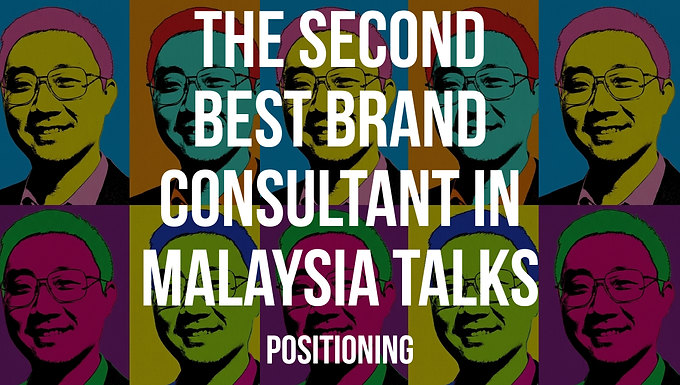
Between 2002 and 2004, Mohd Izani Ashari led a two-year brand-transformation project as the Executive Director of Special Projects at Khazanah Nasional Berhad (Malaysia’s sovereign wealth fund). Azani was already an accomplished project leader for business transformation programmes, but brand was a different beast altogether.
The greatest barrier to brand building is actually the chief executive’s understanding on the meaning and implications of branding.
More than 2 decades later, branding is still very much misunderstood in this country. Today’s focus will be on positioning and if I had to recycle Izani’s words from his interview with Yasmin Merican above, I would say that:
The greatest barrier to positioning is actually the marketer’s understanding on the meaning and implications of positioning.
The American Marketing Association (AMA) defines brand positioning as such:
Brand positioning is the process of defining an organization’s position in the market relative to its competitors.
Brand positioning creates a guide for the effective communication of a brand’s value and benefits to the target audience. It also helps in differentiation and establishing competitive advantage.
This definition brings a lot to the table. So many moving parts. Most practitioners end up using a template like below:
For [Target Customer], who needs [Need/Pain Point], [Your Brand Name] is a [Product Category] that [Key Benefit/Differentiator], unlike [Primary Competitive Alternative], because [Proof/Reason to Believe]"
Which then begs the question: Do I, as a consumer, ever position a brand in such a manner?
My answer is No.
If you, as a consumer, says Yes, I would like to have a quick interview with you. Maybe we can do it in a podcast. Drop me a DM.
Here’s how my primitive brain works as a consumer, despite being a brand strategist:
This is the best toothpaste for me, because it’s just the right amount of ‘spice’.
This is luxury, this is premium, this is mid, this is value, this is cheap.
This is the biggest brand, this is the closest competitor, these are the other options.
This brand is special to me because I grew up with it.
All of the above represent some small part of the templated positioning statement but almost never all intersect in such a way where everything fits in nicely per the marketer’s definition.
If I were to grill a marketer on their target audience and their positioning statement, they would probably concede that only a fraction of their actual customers fit whatever is in their beautiful decks, especially when it comes to low involvement purchases and commodities.
Al Ries and Jack Trout, in their seminal marketing book ‘Positioning’ (2001), argues that the average person cannot tolerate being told he or she is wrong. Mind-changing, especially via a weak force like advertising, is a road to disaster. The best marketers can do is to oversimplify.
So here’s my oversimplification of positioning, for practitioners.
Positioning is a comparison of what is and what’s not.
Here’s an example I’m glad to provide.
Seah, Eu Jeen is the second best brand consultant in Malaysia.
I’m telling you I’m second.
I’m not the best.
I’m a brand consultant.
I’m not a business or marketing consultant.
I’m in Malaysia.
Anywhere else, I might still be in the top10 OR maybe even THE BEST. Who knows?
All we know is that I’m the second best brand consultant in Malaysia 😉 wink wink.
PSSST! If anyone ever asks you for a recommendation for the best brand consultant in Malaysia, please tell them that you don’t know who the best is, because that’s really very subjective BUT you know who the SECOND BEST brand consultant is.
Eu Jeen Seah, the second best brand consultant in Malaysia according to Google's AI Mode
If you don't trust me, maybe you'll trust Google's AI
Parting Thoughts.
One of my challenges when it comes to positioning is the concept of categories. Categories work in a supermarket or on reports because it makes things tidy. Categories don’t work the same way for me. But maybe it’s because I’m Malaysian.
When I am hungry, I go to the hawker centre.
Malay, Chinese, Indian, Western (apologies to Europeans and North Americans. The hawkers usually lump you together), Japanese, Korean, Vietnamese, Indonesian, Thai and regional variations of each will be available.
Do you consider these cuisines as categories?
My gut works this way:
I want something salty.
I want some carbs.
How the hawker centre categorizes the cuisine or how the hotel buffet separates the stations makes no difference to me apart from helping me find my food faster.
Recent developments on understanding category entry points (CEP) by the Ehrenberg-Bass Institute seem a little more promising and useful as compared to preparing the traditional, templated positioning statement. Perhaps this is because these entry points have a lot more to do with goals rather than categories. (I'll write more on CEPs in 2026!)
But enough about my own personal thoughts on positioning.
What are yours?
P/S. Here's some leftover content from the 'Brand Strategy' piece.
品牌定位 (pǐnpái dìngwèi) OR Brand Positioning
Breakdown:
定 (dìng) – to fix, to settle, to decide or reserve
位 (wèi) – position, location
品牌定位 (pǐnpái dìngwèi) = brand positioning = fixing/reserving the mental position your brand occupies.
And you sure as hell will not be able to fit that entire positioning statement in your audience's mind when all they're looking for is a quick bite!